
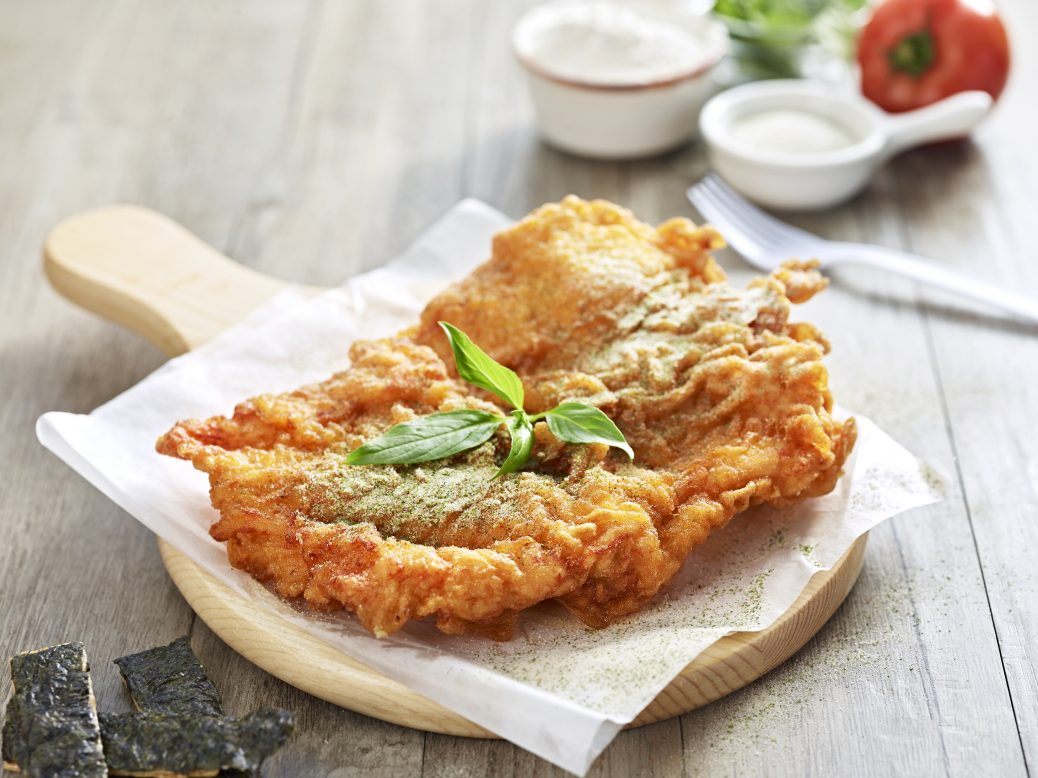
Authentic Taiwan fried chicken in Singapore comes down to a few things: a sweet potato starch batter, a long marination, fresh-fried basil, and night market tradition. I Love Taimei follows all of them — and goes one step further by using chicken thigh instead of the more traditional breast, for noticeably juicier meat. Available across 14 outlets island-wide, with online ordering at go.momos.com.
This is the complete guide to what Taiwanese fried chicken actually is, how to tell the real thing from a generic imitation, how it differs from Korean fried chicken, and where to get it done properly in Singapore.
What makes Taiwanese fried chicken different?
Taiwanese fried chicken — xian su ji (鹹酥雞) in Mandarin, literally “salty crispy chicken” — is a night market staple. It’s not the breaded, sauced, plate-sized fried chicken from Western fast food chains. It’s marinated chicken coated in a thin sweet potato starch batter, fried until shatteringly crisp, and finished with spice powders rather than a wet sauce.
The format traces back to vendors in Tainan who adapted American fried chicken techniques and made them their own — lighter batter, more seasoning control, smaller portions designed for walking through a night market. Wikipedia’s entry on Taiwanese fried chicken cutlet covers the background.
A few things define the style:
- The batter. A rice flour and sweet potato starch blend creates a translucent, paper-thin crust that absorbs less oil and stays crisp longer. If the batter looks thick and opaque — like standard wheat flour breading — you’re looking at something else entirely.
- The basil. The most distinctive finishing touch is fresh Thai basil, fried separately and served on top — not mixed into the batter. It wilts and crisps into something aromatic and slightly anise-like. In the authentic version this is non-negotiable.
- The seasoning. Five-spice, white pepper and garlic do the work, with spice powders (curry, chilli, garlic salt) added after frying, never during — adding them mid-fry would just burn them.
- Fresh to order. A single fresh fry, cooked through in one pass, straight to order. No pre-cooking, no holding under a heat lamp.
Taiwanese vs Korean fried chicken
Korean fried chicken has had a huge moment in Singapore, so it’s worth knowing how the Taiwanese style is a different experience entirely:
- Batter. Taiwanese uses sweet potato starch for a craggy, shattering crust; Korean uses a thin, translucent shell.
- Flavour. Taiwanese is dry and aromatic — five-spice, white pepper and garlic applied before frying. Korean is glazed after frying in sweet-spicy sauces like gochujang, honey or soy garlic.
- Basil. Taiwanese is finished with fresh Thai basil fried alongside and served on top. Korean doesn’t use it.
- Format. Taiwanese is sold by weight or as one large slab — the XXL piece is iconic. Korean comes as whole pieces, like half a bird or full wings.
- Price. Taiwanese is street-food pricing; Korean is closer to restaurant pricing.
Neither is “better” — it comes down to whether you want a dry, aromatic, seasoning-led crust or a sauce-glazed one.
How to spot authentic Taiwanese fried chicken
Because the dish has become popular, there are plenty of imitators. Three quick checks:
- Look at the batter. Authentic recipes use a thin, translucent coating. A thick, opaque white batter usually means a generic fried-chicken preparation, not the Taiwanese street style.
- Check the seasoning station. Legitimate stalls add spice powders — curry, chilli, black pepper — after frying, not in the batter.
- Look at the menu around it. In Taiwan, fried chicken is never sold in a vacuum; it sits alongside tempura, bubble tea and other night market staples. A shop that serves it in isolation is a red flag.
Why I Love Taimei uses chicken thigh instead of breast
Here’s where ILTM diverges from the textbook recipe.
Traditional Taiwanese fried chicken — the night market kind you’d find at Shilin or Raohe in Taipei — typically uses chicken breast. Breast has been the default cut at Taiwan night market stalls for decades, and most fried chicken shops in Singapore replicate that.
I Love Taimei does it differently. Since 2009, ILTM has used chicken thigh for its XXL Taiwan Fried Chicken — a deliberate choice based on food science. Thigh meat has more intramuscular fat than breast, and that fat renders during frying to keep the inside juicy even after the crust has crisped. Breast meat dries out fast at the high temperatures night-market-style frying demands.
The trade-off is worth it. Thigh costs more per kilogram and takes slightly longer to cook through, but the result is meat that stays juicy through the whole eating experience — which matters a lot more when you’re paying $7 to $10 for a single piece. You can read more about why thigh matters for Taiwanese fried chicken.
The 24-hour marination that most shops skip
Marination is the second pillar of authentic Taiwanese fried chicken.
The traditional approach involves marinating chicken for an extended period — hours, ideally overnight — in a blend of soy sauce, garlic, five-spice powder, and other seasonings. This allows the flavour to penetrate the meat rather than sitting only on the surface.
I Love Taimei marinates for 24 hours. The reason is simple: flavour penetration. A short marination gives you surface seasoning. Twenty-four hours means the meat itself tastes like the spices, so every bite — not just the crust — carries that savoury five-spice character you associate with Taiwan night markets.
Most shops in Singapore don’t do this. They marinate for a few hours, which is faster and cheaper operationally. The difference is noticeable when you eat them side by side — one has flavour that stops at the crust, the other carries it through to the bone.
If you haven’t tried ILTM’s fried chicken yet, start with the XXL piece at Bugis Junction (230 Victoria St, #B1-K11 to 11A, Singapore 188024) — it’s one of the most central outlets and open daily from 11:00 to 22:00.
Where to find it — 14 outlets, no pork, no lard
I Love Taimei has been operating since 2009. The brand is women-owned, with 14 outlets spread across Singapore — from Punggol in the north to Bukit Batok in the west. Every outlet serves the same XXL Taiwan Fried Chicken, prepared with the same thigh meat and 24-hour marination.
The outlets are at Waterway Point, Sun Plaza, SingPost Centre, Northpoint City (Yishun), Junction 8 (Bishan), Lot One, Sengkang Grand Mall, The Woodleigh Mall, Hillion Mall, Nex (Serangoon), The Clementi Mall, Bugis Junction, West Mall (Bukit Batok) and Tampines 1 — likely one within a few MRT stops of wherever you are.
One thing worth noting: all food at I Love Taimei is made with no pork and no lard. The brand is not halal-certified, but the kitchen policy means the food doesn’t contain any pork products or lard-based ingredients. For a full breakdown of dietary information, read the halal status guide.
Pair the chicken with a Brown Sugar Bubble Tea — the earthy sweetness balances the savoury five-spice crust — for the full Taiwan night market experience.
Find your nearest outlet: https://ilovetaimei.com/places/
FAQ
What makes Taiwanese fried chicken authentic?
Authenticity comes down to the cooking method — sweet potato starch and rice flour batter, not wheat breading; extended marination with five-spice and garlic; fresh-fried basil; spice powders added after frying; and chicken cooked fresh to order. These are the standards established at Taiwan night markets, not marketing choices.
How is Taiwanese fried chicken different from Korean fried chicken?
Taiwanese fried chicken uses a sweet potato starch batter and is seasoned dry — five-spice, white pepper, garlic — and finished with fresh Thai basil. Korean fried chicken uses a thin batter and is glazed after frying in a sweet-spicy sauce like gochujang or soy garlic. One is seasoning-led; the other is sauce-led.
Why does I Love Taimei use chicken thigh instead of breast?
Chicken thigh has more intramuscular fat, which renders during frying and keeps the meat juicy. Breast meat dries out quickly at the high temperatures used in night-market-style frying. I Love Taimei has used thigh meat since 2009 — it’s part of the original recipe, not a recent change.
How long does I Love Taimei marinate the chicken?
24 hours. The extended marination ensures flavour penetrates the meat rather than staying only on the surface. This is what separates a piece of chicken that tastes seasoned from one that just has seasoning on it.
Is Taiwanese fried chicken spicy?
Not inherently. The base is savoury and salty, seasoned with garlic and pepper. Spice level is customisable with chilli powder added after frying, so you can keep it mild or make it fiery.
Is I Love Taimei halal-certified?
No. I Love Taimei is not halal-certified by MUIS or any certifying body. All food is prepared with no pork and no lard, but the brand has not applied for halal certification.
Where can I order Taiwan fried chicken in Singapore?
I Love Taimei has 14 outlets island-wide. You can order online at go.momos.com or visit any outlet directly. For the full menu, check ilovetaimei.com/menu.
Related Reading
- Taiwanese Fried Chicken: Thigh vs Breast — why ILTM uses chicken thigh, deeper dive
- Xian Su Ji (Salt Pepper Fried Chicken) — the Mandarin name and what it means
- Best Taiwanese Popcorn Chicken in Singapore — the bite-sized cousin, yan su ji
- Late-night Supper Fried Chicken at Tampines MRT — for after-work cravings
Order from the full menu here: https://go.momos.com/ilovetaimei
Taste it for yourself — 14 outlets island-wide. No pork, no lard.


